John William Hynton was born May 26, 1850 in Northfield, Summit County, Ohio to John and Elizabeth (Halpenney) Hynton, both natives of County Wicklow, Ireland. His father was a prosperous farmer who purchased a brick house on the Ohio Canal known as the Frazee House or Frazee-Hynton House. The building still stands today and is located within the Cuyahoga Valley National Recreation Area.
John appears in the 1850 census in Northfield with his father and mother, siblings Mary and Catherine, and a 17 year old Irish native named Mary Howard, possibly a servant. His father’s real estate was valued at $1,500.
John appears in the 1860 census in Northfield with his father, mother, and siblings Mary, Catherine, and Elizabeth. His father’s real estate was valued at $4,500 and personal property worth $1,000.
John’s father died in September of 1865 when he was fifteen years old. His mother maintained the farm and household and remained there until her death in 1896.
By 1869, John was the owner of 134 acres in Independence Township, Cuyahoga County, Ohio worth $2,141, according to tax records.
John appears in the 1870 census in Independence with his mother “Elizabeth Hienton,” sister Elizabeth, Catherine Lamb (an eleven year old girl), and William Murphy. Their real estate was valued at $4,350 and personal property worth $2,300.
On November 18, 1870, John’s mother Elizabeth distributed 144 acres of land to him, which he then conveyed to A.K. Richey. His mother also conveyed another tract of land worth $6,175.
At the age of 25, on May 23, 1876, John married Anna Marie Cassidy, daughter of Patrick Cassidy and Margaret Glancey, another family of prosperous Irish immigrant farmers. They were residents of Boston Township, Summit County, further up the Cuyahoga River. John likely became acquainted with Anna through the marriage of his younger sister, Elizabeth, to James Cassidy, one of Anna’s older brothers, in 1871.
John and Anna had 12 children: Lucy Maybell Hynton; Anne Blanche Hynton; Francis Edward Hynton; John Patrick Hynton; William Raymond Hynton; Margaret Estella Hynton; Grace Mary Hynton; George Lewis Hynton; Andrew Robert Hynton; William E. Hynton; Lillian E. Hynton; and Anna (“Babe”) Hynton.
John and Anna are found in the 1880 census in Northampton Township, Summit County, Ohio (now part of Cuyahoga Falls), along with children Mabel, Agnes B. and Francis, and servants William Elliott and Katie Cassidy. John is listed as a farmer.
Cassidy v. Hynton decision in Northeastern Reporter
Sometime after 1880, John became involved in litigation over his father’s will, which set up a trust for his wife and four children. Apparently, two of the children (Catherine and Elizabeth Hynton Cassidy) were upset that their mother had distributed the lion’s share of the estate to John and his sister Mary, so they brought a lawsuit against them. In January 1886, the Supreme Court of Ohio rendered a decision against John. Ultimately, the court would order John would have to convey his lands back to his siblings.
From 1896 to 1898, John was being pursued by creditors and had to make an assignment for the benefit of creditors. An assignment for the benefit of creditors is a common law contract for dealing with an insolvency situation, an alternative to bankruptcy. Not only was John dealing with the expense and results of the lawsuit, but the mid-1890s were also a period of economic depression.
It appears that by 1900, John had lost any wealth he inherited from his parents and any real estate holdings. He is listed as a fireman living in a rented home on Water Street in Kent, Ohio. He is listed in the census with his wife and eleven children.
In 1910, John was living at 602 Harris Street. This time, he owned the home and was listed as a farmer. Three of his sons were working in the Akron rubber works. His daughter Grace would eventually go to work in the Falls Rivet Works in Cuyahoga Falls.
Around 1916, John found employment with the Western Reserve Milk Co. plant and worked with them until his death eight years later.
John had two sons who fought in World War I: Andrew Robert and George Lewis. In November 1918, John’s daughter Lillian died as a result of the influenza pandemic.
In 1920, John was still living at 602 Harris Street at 71 years old. His occupation is listed as truckman.
Anna died in 1922.
Around 1923, John suffered a paralytic stroke while he was working. He died at the age of 74 on October 2, 1924 from cerebral apoplexy. At the time, his address was 606 S. Water Street in Kent. John and Anna are buried in Standing Rock Cemetery, Kent.
William Davidson Fuller was born on March 22, 1854 in Farmington, Peoria County, Illinois to James and Margaret (Davidson) Fuller. Sometime shortly after his birth and before the birth of his brother Charles in 1856, his family moved approximately 80 miles north to Walnut, Bureau County, Illinois. His father had purchased land there, which was worth $2,000 by the time of the 1860 census, in which William is enumerated with his mother and father, sister Agnes, brother Charles, sister Sarah Jane, and an 18 year old farm laborer named William Phillips.
William was still a young boy during the Civil War. His father was in his forties and most likely did not serve. In the summer of 1865, a few months after the end of the war, his sister Sarah died.
In the 1870 census, William was 16. Also listed are his parents, siblings Agnes, Charles and possibly another sister named Clara, born about 1865. Also in the household are a 15 year old domestic servant named Paulina McNitt and a 30 year old Swedish farm laborer named Swan Peterson. The value of his father’s farm had increased to $8,500.
Marriage License of William D. Fuller and Gertrude H. Rodd
Sometime in the late 1870s, William met Gertrude Helen Rodd, a native of England who immigrated as a young girl. The circumstances by which Gertrude came to the United States and ended up in Bureau County, Illinois are a mystery. Possibly, she may have worked at James Fuller’s farm or a nearby farm as a domestic servant. William and Gertrude married on February 13, 1878 in Princeton, the county seat of Bureau County. William and Gertrude had seven children together: William James, Charles Arthur, Margaret Ellen, James Davidson, Harry Thomas, Frank, and Frederick.
By 1880, William and Gertrude moved over the county line to Hamilton Township, Lee County, Illinois where they are found in the census with their 1 year old son William. Sometime between 1882 and 1885, judging from the birthplaces and birthdates of their children, William and Gertrude moved to Clay Center, Clay County, Nebraska. They are enumerated in Marshall Precinct, Clay County in Nebraska’s 1885 census. They returned to Bureau County sometime after 1888 (when their son Harry was born).
In 1897, William’s father died. The following year, the Bureau County Tribune announced that “W.D. Fuller” was establishing a “new brick store.” It is possible that he inherited some money from his father.
In the Bureau County court records around this time, there is a proceeding in which William declared his mother insane. Margaret was around 80 years old at the time and it is possible that she had dementia. William likely stepped in after James died to help manage her affairs.
In the 1900 census, William is listed in Walnut, Bureau County, Illinois as a plumber. He owned his property free and clear. All William and Gertrude’s children are listed in this census.
In 1901, Robert J. Rodd, an enterprising cousin of William’s wife, transferred a small parcel of land on Northampton Avenue in Cuyahoga Falls, Summit County, Ohio to William. Robert was the superintendent at the Falls Rivet & Machine Company in nearby Kent, Ohio. William’s sons Charles and Harry would find employment there.
In 1904, William and Gertrude booked a passage across the Atlantic to visit England. They may have visited some of William’s relatives on his father’s side around Bobbing, Kent or some of Gertrude’s Rodd or Beauchamp relatives.
In 1908, William applied for a homestead from the Canadian government on the prairies of Alberta, Canada. From the homestead records, it appears that William went through the process to become a Canadian citizen. He claimed lands in La Pearl, which is close to Edmonton. He made the long journey west a number of times; however, in October 1910, ill health caused him to leave and return to Ohio. Doctors were scarce in Alberta at this time, which likely necessitated the move back to the United States.
On February 15, 1911, William died at the age of 56 of chronic interstitial nephritis, an inflammation of the kidney typically caused by reaction to medication. He is buried in Oakwood Cemetery in Cuyahoga Falls.
Washington County portion of 1814 map of Maryland by Henry Charles Carey
Jacob Stouffer (also Stauffer or Stover) was a farmer born about 1765 in Lancaster County, Pennsylvania, the son of Jacob and Margaret (Martin) Stouffer. Along with several other German-speaking Mennonite families of Lancaster County, Jacob moved southwest to Washington County, Maryland where he married his wife sometime before 1791. For a long time, researchers thought that the wife of Jacob Stouffer was named Margaret “Peggy” Stoner. It appears that a researcher confused this Jacob Stouffer with another Jacob Stouffer who married Margaret Stoner, daughter of John and Elizabeth (Barr) Stoner around 1814. Later genealogists have identified this error, but unfortunately other researchers have replicated this mistake over and over on online trees.
So if Jacob Stouffer’s wife was not Margaret Stoner, who was she? This post proposes that his wife was Mary Witmayer, daughter of George and Mary Witmayer of Washington County, Maryland.
According to Jacob’s 1822 will, found in the probate records of Washington County, he had the following children: Mary Witmayer (a step-daughter); John Stouffer; Jacob Stouffer; George Stouffer; Samuel Stouffer; Elizabeth Stouffer; Peter Stouffer; David Stouffer; Elias Stouffer; Catherine Stouffer; Joseph Stouffer; Emmanuel Stouffer and Amelia Stouffer. Jacob’s wife is not mentioned in his will, so apparently she died sometime after their last child’s birth (1817) and the will’s execution (1822).
Jacob Stouffer can be found in the 1810 census in Sharpsburgh Hundred, Washington County with 3 males under 10, 2 males 10 to 15, 1 male over 45, 2 females under 10, 1 female 16 to 25, and one female 26 through 44 (Jacob’s wife). He is found in the 1800 census in Upper Antietam Hundred, Washington County with 4 males under 10, 1 male 26 through 44 (Jacob), 2 females under 10, and 1 female 26 through 44 (Jacob’s wife).
According to the census records and the date of Mary Witmayer’s birth, which we know to be 1788 from Stauffer family Bible records, Jacob’s wife would have been born sometime after 1766 and no later than 1770.
For years, I had assumed that Mary Witmayer was Jacob’s wife’s daughter from a previous marriage. I had searched in vain for a Witmayer marriage in Washington County dating prior to Mary’s birth. However, with the help of genetic genealogy, I began finding several DNA connections to descendants of Jacob Stouffer with Whitmore/Witmayer ancestors in their online trees. This suggested to me that Witmayer actually may have been Jacob’s wife’s maiden name. The step-daughter Mary may have been an illegitimate child.
There was a George Witmoyer in Washington County, who I believe to have been Jacob’s father-in-law. His will, dated February 2, 1799, states that he was living in Lower Antietam Hundred, identifies a wife named Mary, a son named Abraham and daughters Matlanah (Madlena?), Elizabeth, Catherine, Susannah. The second page of the will is missing from the FamilySearch images, but available text refers to “other children” who “left” him. More interestingly, the 1803 distribution record of George Witmoyer’s estate provides more details as to his children. It lists the following individuals: Mary Witmoyer (the wife), Barbara Funk, Ann Myers, Mary Stover, Francy Grove, Matlena Fryor, Esther Horine, Elizabeth Witmeyer, and Susannah Mason. Catherine and Abraham are not listed in the distribution, so they may have died sometime between 1799 and 1803. I believe that the Mary Stover in the distribution is the wife of Jacob Stover/Stouffer.
Record of Distribution from George Witmoyer’s Estate, Washington County, Maryland Probate Records (courtesy of FamilySearch)
Notably, there is a George Whitmire in the 1790 census with a household with 1 male over 16, 1 male under 16 and 7 females. 5 of the females may be the women specifically mentioned in the will while remaining two could be Mary Witmoyer (later Jacob Stover’s wife) and Mary Witmoyer, her daughter.
As stated above, genetic genealogy provides additional evidence that the Mary Stover listed in the distribution of George Witmoyer’s estate was in fact the wife of Jacob Stouffer. The analysis below is done primarily from the AncestryDNA matches of my mother, a descendant of Jacob Stouffer’s son Joseph.
First of all, I was able to identify several descendants of Jacob Stouffer and his several children in my mother’s match list. Then, I began noticing that several of them are related to descendants of the other individuals who appear in the distribution of George Witmoyer’s estate. I initially used the AncestryDNA Groups color codes to identify Stauffer/Stouffer/Stover matches, but created another one as I began to identify probable descendants of George Witmoyer and his wife Mary.
Barbara Funk (1762-1831), I believe, is the wife of Martin Funk (1761-1849). They moved to Warriors Mark, Huntingdon County, Pennsylvania. Most published family histories list the wife of Martin Funk as Barbara Catherine Ednire, Etnire or Eitniear, daughter of Johannes and Margaret Edeneyer. I suspect that this is a mistake. I looked at Johannes (John) Eitniear’s will in 1766 (Washington County was part of Frederick County, Maryland then) and noted that he had a daughter named Catherine rather than Barbara. On the other hand, Barbara’s gravestone does not have the additional name of Catherine. DNA evidence, however, strongly suggests that Barbara Funk was a Witmoyer. So far, I have identified at least twelve DNA matches who are descendants of Martin and Barbara Funk and are also DNA matches with descendants of Jacob Stouffer.
Ann Myers was probably the wife of Daniel Myers. I found record of an Anna Whitmire born April 9, 1761 and died February 11, 1841 in Birmingham, Huntingdon County, Pennsylvania. They had at least four children. So far, I have identified at least two DNA matches who are descendants of Daniel and Anna Myers and are also DNA matches with descendants of Jacob Stouffer.
Francy or Fanny Grove was probably the wife of Peter Grow (1770-1816). They moved to Jessamine County, Kentucky along with several Maryland families associated with the Church of the United Brethren. So far, I have identified at least two DNA matches who are descendants of Peter and Fanny Grow and are also DNA matches with descendants of Jacob Stouffer.
Matlena Fryor is possibly Magdalena (1778-1840), wife of Bennett Fryer or Fryar born 1776 in Maryland and died October 18, 1851 in Wayne County, Indiana. Bennett and Magdalena moved to Fayette County, Kentucky before 1810, Darke County, Ohio by 1820 and finally to Wayne County, Indiana by 1830. They had at least three children: George, Elizabeth and Magdalene. So far, I have identified at least four DNA matches who are descendants of Bennett and Madalena Fryer and are DNA matches with descendants of Jacob Stouffer.
Esther Horine was probably the wife of Henry Horine (1776-1852). They moved to Jessamine County, Kentucky around 1795, along with other United Brethen settlers from Maryland, and had eleven children: David, John, Adam, Peter, George, Sarah, Joshua, Catherine Christopher and two others. Tradition was that Henry arrived in Kentucky with nothing but $2.50 and an ax on his shoulder. He cleared land, became a prosperous farmer and was antislavery despite living his whole life in the South. So far, I have identified at least four DNA matches who are descendants of Henry and Esther Horine and are also DNA matches with descendants of Jacob Stouffer.
Elizabeth Witmyer was possibly the wife of Nicholas Goshorn (1782-1868). It appears that they were married in 1806 (notably after the 1803 estate distribution whereas Elizabeth appears with her maiden name) and lived in Huntingdon County, Pennsylvania. It is likely that Elizabeth went to Huntingdon County to live with her sisters Barbara Funk and Ann Myers and met Nicholas there. So far, I have identified at least ten DNA matches who are descendants of Nicholas Goshorn and Elizabeth Whitmore and are also DNA matches with descendants of Jacob Stouffer.
There was a Catherine Witmoyer who married Adam Horine in Washington County in 1800. It’s possible that she died prior to the distribution in 1803 and therefore was not listed. Adam died around 1812 and his brother was appointed guardian of his children, suggesting that his wife died at least prior to that date. It appears that Adam had children born after 1803, so these are possibly from a second marriage. Another possibility is that Catherine was inadvertently omitted from the distribution list, possibly because there was another daughter who married a Horine (Esther).
So far, I have not been able to find more information on Susannah Mason. However, it appears that Matlena’s daughter Elizabeth Fryer married a Solomon Mason, son of Christopher and Charlotte (Shortland) Mason. Perhaps this Mason family is connected somehow to Susannah’s husband.
Clicking on these matches also reveals connections with other descendants of George Witmoyer. The distribution record from the estate helps give documentary evidence as to how these Funk, Myers, Stauffer, Horine, Grow, Fryer, and Goshorn families are all connected.
The reasons why not much was previously known about this side of the family to the Stauffer descendants is understandable. Mary Witmoyer Stauffer died sometime between 1817 and 1821. By that time, it appears that all of her sisters had moved away from Maryland to either Huntingdon County, Pennsylvania or Jessamine County, Kentucky. Joseph, my ancestor, would have been less than ten years old by the time both his mother and father died. One of his Stauffer uncles served as his guardian and the other two do not appear to be related to either the Stauffer or Witmoyer families. Accordingly, any connections to his mother’s family would have been scarce.
I look forward to the possibility of tracing the Witmoyer family back further generations. I also do not yet know George’s wife’s maiden name. Genetic genealogy may help unlock the secrets to that mystery as well.
If you descend from any of the families mentioned above, I would love to hear from you.
SOURCES
Margaret Harris Stover, A Midwest Line of Descent from Matthias Stouffer of Lancaster County, Pennsylvania (2008).
Portrait and Biographical Album of McLean County, Illinois, 192
Washington County, Maryland Probate Records (available on FamilySearch)
Genealogy of the Houser, Rhorer, Dillman, Hoover Families (1910), p. 73
United States Census Records 1790, 1800, 1810, 1820, 1830, 1840
My ancestor Rebecca Bowersox, wife of George Holder, was born about 1803 in Pennsylvania according to most of the census records she appears in as well as the census records and death records of her children. However, the 1900 census record for her son John Holder lists her birthplace as “at sea.”
Names of Rebecca’s parents provided in her Michigan death record
Rebecca’s death record in Michigan states that her parents were George and Sophia Bowersox. Her entry in the 1880 census states that both of her parents were born in Pennsylvania. However, her 1870 census entry states that her parents are of foreign birth. However, taking a look at that census page, it looks like the enumerator was checking the foreign birth checkboxes for every single person, so this may be an error.
So far, I have not been able to find a George and Sophia Bowersox in Pennsylvania records or books on Bowersox genealogy. There is a George Bowersock in the 1800 census in Penns, Northumberland County, Pennsylvania, but I have not yet been able to determine if he is the correct George. I have tried to see if other Bowersox families lived close to Rebecca and her husband George Holder in Venango County, Pennsylvania or surrounding counties. Interestingly, my father and I have several DNA matches who are descendants of John Bowersock (1805-1833) who also lived in Venango County in the early 1800s. John married Rebecca Webber and had three children: Mary Rose Ann Bowersock, James Foster Bowersock, and George R. Bowersock. In 1830, he was living in Scrubgrass Township. He also appears in the Venango County probate records around 1833. Because of the DNA matches and geographical connection, I believe that John was Rebecca’s brother.
Additional DNA matches descend from the Bowersox/Bowersock/Bauersachs family of Pennsylvania. Immigrant ancestors include Georg Adam Bauersachs (1744-1817) who came from Memmelsdorf, Bavaria and Paulus Bauersachs (1744-1805) from Weingarten, Baden-Württenmberg. The common Bauersachs DNA ancestor may be a butcher named Johann or Hans Bauersachs born about 1665 in Germany.
As mentioned above, Rebecca married George Holder, possibly the son of Charles Holder and Peggy Klingensmith of Armstrong County, Pennsylvania, sometime in the early 1820s. By 1830, they were living in Plum Township, Venango County with three daughters under the age of five. One of these girls would have been their daughter Mary C. Holder.
In 1840, Rebecca and George were still living in Plum Township. Their family had increased to eight children. This would have included the three daughters from the 1830 census plus Catherine, Samuel, Rebecca Jane, John, and Martha.
Sometime between 1843 and 1846, George and Rebecca moved to Liberty Township, Trumbull County, Ohio. They appear in the 1850 census there with children John, Catherine, Joseph, Sarah, Serilla and Nelson. The birthplaces of the children help establish probable dates for the move from Pennsylvania to Ohio (Sarah was born about 1843 in Pennsylvania and Serilla was born about 1846 in Ohio.
George purchased three acres of land in Liberty Township for $100.00 from John Ferguson of Vienna Township. This property is located in the north central portion of the township near present day Ohio State Route 193.
George and Rebecca appear in the 1860 census in Liberty Township with their sons Joseph and George Nelson. George probably died sometime between 1860 and 1870, passing the three acres on to Rebecca through intestate succession. No probate records exist for George Holder in Trumbull County.
In the 1870 census, Rebecca is enumerated in Liberty Township, Ohio in a household with her son George Nelson Holder, grandson Samuel Bartholomew and granddaughter Martha Susan Bartholomew. Samuel and Martha were children of Rebecca’s daughter Catherine who had married Erastus Bartholomew. Erastus had fought as a Union soldier in the Civil War and died in Andersonville Prison. Rebecca had real estate valued at 800 and personal estate valued at 400. It is possible that Catherine sent Samuel and Martha to help Rebecca and Nelson with the farm.
Even though, the 1870 census indicated that Rebecca owned real estate, she had already deeded the property to her son George N. Holder on September 4, 1869 and the deed was recorded within the same month. (Trumbull County Deed Record, Vol. 101, Page 639).
Portion of Deed Record from Rebecca Holder to George N. Holder
Sometime between 1870 and 1880, Rebecca moved to Porter, Van Buren County, Michigan to live with her son Joseph. She died April 13, 1886 in Prairie Ronde, Kalamazoo County, Michigan.
Are you a descendant of Rebecca Bowersox and George Holder? Do you have any additional information on them? Please let me know in the comments.
SOURCES
United States Census 1830, 1840, 1850, 1860, 1870
Michigan Death Records, 1867-1950
Pennsylvania Death Certificates, 1906-1963
Trumbull County Deed Records, 1795-1947 (available at FamilySearch)
Thomas L. Bauersox, Our Family Tree, Vol I., Paulus Bauersachs, 1146-1975 (May 1976)
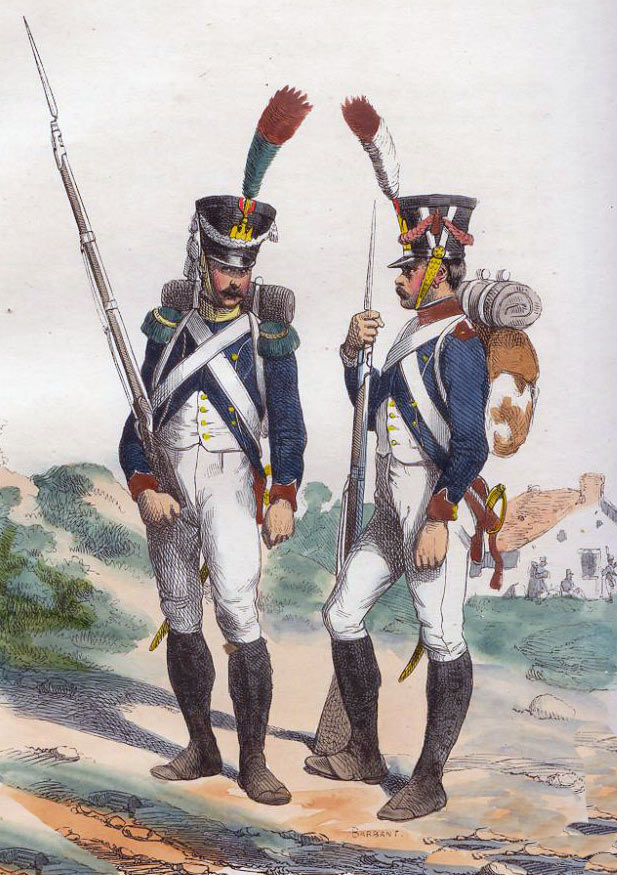
Tirailleur and Voltigeur of the French Infantry: Battle of Salamanca on 22nd July 1812 during the Peninsular War: picture by Hippolyte Belangé
Growing Up in Occupied Territory
The town of Ober Ingelheim is situated in southwestern Germany, near the left bank of the Rhine River. It is a hamlet nestled among rolling vineyards with a history extending back to the year 1200. It was here, on August 27, 1791, that my ancestor Peter Philipp Emrath was born to Karl Wilhelm Emrath and his wife Anna Margaretha Menk. Peter had an older brother, Johann Karl, but no other known siblings.
In 1791, Ober Ingelheim was situated within the Ingelheimer Grund or Ingelheimer Reich (Empire), directly linked to the Holy Roman Empire. Parts of the surrounding countryside belonged to the Electoral Palatinate (Pfalz). Over the following decades, this region would experience tumultuous political change and war.
Around the time of Peter’s birth, neighboring France was in the throes of its Revolution. Events there would shape the course of much of his early life. By 1792, during the War of the First Coalition, French Revolutionary troops occupied nearby Ingelheim and eventually the entire left bank of the Rhine including the cities of Mainz, Worms and Speyer. Prussia recognized France’s claims to this area in 1795. In 1798, France formally annexed the region, creating the department of Mont-Tonnerre. Although this area was German-speaking, it was now effectively part of France.
By Louis Brion. Voyage dans la ci-devant Belgique, et sur la rive gauche du Rhin. Paris 1802 – Museum bei der Kaiserpfalz, Ingelheim, Public Domain, Link
France would eventually fall under the rule of Napoleon, who went to war against other countries in Europe including Austria, Prussia, Russia and Britain. A history of Ober Ingelheim states that, during the Napoleonic Wars, Peter Emrath served in the 86th Line Infantry Regiment in Spain for three years. By law, any male who reached his 20th birthday became eligible for conscription into the French Army in the same year. Accordingly, Peter would have been eligible for conscription in the year 1811.
In 1811, the 86th Line Infantry Regiment was in Portugal fighting in the Peninsular War. Napoleon had sent troops to Portugal to enforce his Continental blockade. He also deposed Spain’s Bourbon monarch and installed his brother Joseph Bonaparte on the Spanish throne. The British Army came to the Iberian Peninsula to assist Bourbon Spain and Portugal against the French. In May of 1811, the Army was reorganized and the 86th Line Infantry Regiment was placed under the leadership of General Antoine Louis Popon de Maucune.
During the period that Peter served with the 86th Line Infantry Regiment, he would have witnessed a series of crushing defeats. At the Battle of Salamanca, the French Army, assuming that Wellington was taking a defensive position, allowed the 86th Regiment and others to be cut off from the the rest of the army. British general Stapleton Cotton attacked the isolated regiments with muskets and a cavalry charge. The battle resulted in at least 14,000 casualties for the French Army while the British suffered only half that amount.
The Siege of Burgos
Wellington followed up his victory at Salamanca by taking Madrid and sending King Joseph Bonaparte fleeing. The French Army abandoned several of its positions across Spain and attempted to regroup. By September, Wellington turned his attention to the French garrison at Burgos where he began a siege. The 86th Regiment participated in the Siege of Burgos. However, this siege was ultimately a French victory and Wellington retreated to Portugal. The 86th Regiment camped outside Salamanca over the winter of 1812-13.
Fighting in the Basque Country and the Pyrenees
By 1813, the British pushed the French Army back into Spain’s Basque Country, in the extreme northeast of the country near the French border. In June 1813, British troops surprised Maucune at the Battle of San Millan-Osma. King Joseph thought Maucune’s division had been battered so much during the battle that it was no longer fit for combat, so he assigned it to guard the wagon train. This decision prevented the regiment from assisting in the Battle of Vitoria, which was a decisive French loss and considered a turning point in the Peninsular War. The 86th Regiment returned to fight in the Battle of Tolosa and the Battle of the Bidassoa. After Bidassoa, General Soult relieved Maucune and took command of the 86th Regiment and the Battle of the Pyrennes. By August of 1813, several battalions of the 86th Regiment were sent back to France, but one other battalion continued the fight at the Battles of Orthez and Toulouse. It is not yet known which battalion Peter Emrath was part of.
Fighting in the Peninsular War was especially challenging. The French Army was not only fighting the regular Spanish Army, but also against the British and Spanish insurgents who did not accept French rule. The insurgents prosecuted an irregular war against the occupying army. These tactics gave rise to the term “guerrilla” warfare. The losses in Spain were such that it became known as Napoleon’s ulcer. My Uncle Ralph, who loved reading and recounting military history, told me that members of this family fought under Napoleon and became weary of war. From the descriptions of the battles, Peter likely had harrowing experiences, lost comrades, and witnessed other horrors of war during his years in Spain.
By 1814, with Napoleon’s defeat in the War of the Sixth Coalition, France lost control of the Left Bank of the Rhine. Peter’s hometown of Ober Ingelheim was now in the hands of the General Government of the Middle Rhine. At the Congress of Vienna, the region of Rheinhessen, which included Ober Ingelheim as well as Mainz and Worms, was given to Grand Duke Louis I of Hesse creating the Grand Duchy of Hesse and by Rhine. From then, the Emraths would consider themselves “Hessians.”
Marriage and Children
In March 22, 1817, Peter married Anna Maria (Mary) Emrich, daughter of Johann Christoph Emrich and Maria Elise Rossbach. Unless the year is incorrect, Anna Maria was likely several months pregnant by the time they were married. She gave birth to their first daughter Eleanora in June of the same year. Peter and Anna Maria would have five more children: Peter Jr., Jacob Wilhelm, Katherine Margaret, Ludwig and Philipp.
A New Life in America
In 1845, Peter’s daughter Elenora and her husband Nicholas Barth, an itinerant carpenter also from Ober Ingelheim, emigrated to America, settling first in New York City. His sons Peter Jr.and Jacob emigrated a couple months after them. The Barths and Emraths eventually settled in Jefferson County, Wisconsin. Ludwig immigrated to America around 1850. Life in Germany after the Revolutions of 1848 was difficult and probably encouraged Peter to move overseas as well. By the early 1850s, Peter decided to move with his wife, daughter Catherine and son Philipp to America as well. They sailed on the S.S. City of Manchester from Liverpool, England and arrived in Philadelphia on May 24, 1852.
Peter took up farming in Sumner, Jefferson County, Wisconsin and appears there in the 1860 and 1870 censuses. His wife Mary probably died sometime between 1860 and 1870. Sometime after 1870, Peter moved to Milwaukee, probably to live with his daughter Katherine. He died there on July 24, 1876.
SOURCES
Henri Charles-Lavauzelle, ed., Historique du 86e Régiment d’Infanterie, Paris: Imprimerie Librairie Militaire, (1887)
Rolf Kilian, Die Familien in Ober Ingelheim, 1200-1800 (1961)
Josiah Brown was born January 20, 1816 in West Salem Township, Mercer County, Pennsylvania to Andrew and Mary (McLaughlin) Brown. Both of his parents were of Scots-Irish ancestry. The Brown family extends back to John Brown, a Covenanter martyr of Scotland, who was murdered by James Claverhouse in 1685. The widow of John Brown, who was pregnant at the time her husband was killed, and her young son moved to Ulster Ireland. Her sons eventually found their way to Pennsylvania, where many Ulster Scots were migrating to in the 1700s. The McLaughlins originated the vicinity of Londonderry and also emigrated to Pennsylvania in the 1700s. The Scots-Irish were recruited to settle the Appalachian backcountry. The Browns settled in Dauphin County (near Harrisburg) and the McLaughlins in Mifflin County. Mary’s parents, John and Nancy McLaughlin, settled in Mercer County, Pennsylvania on or before 1801, when John died. Andrew Brown, a great-grandson of the Covenanter martyr, moved to Mercer County with his three brothers and took up lands in West Salem Township around 1800.
Around 1810, Andrew and Mary married and had four daughters and one son (Josiah), all born in West Salem Township. Josiah’s sisters were Sarah, Nancy, Lovina and Mary.
Andrew died in Jul 1823. Josiah’s mother remarried to Richard Morford on September 7, 1827. The Morfords were also a family of Scots-Irish ancestry, but came to Mercer County from New Jersey. Richard had eight children with his first wife, Elizabeth Morford. Richard and Mary had four children together: Emeline Morford, Eliza Morford, Andrew Morford and Richard Judson Morford. With the children from the two previous marriages, plus the addition of these four, the Morford-Brown-McLaughlin household must have been enormous.
On February 25, 1837, Josiah married Mary Morford, daughter of Thomas Morford and Susanna Hazen and also a niece of his step-father, Richard. Josiah and Mary had five children: Thomas Morford Brown, Andrew S. Brown, Mary Melissa Brown (married Dr. Abram B. Cushman), Susan Brown and Curtis B. Brown. Mary died May 7, 1848 at the age of 32.
Josiah married second Permelia Orlina Williams on August 21, 1849. Together, they had eight children: Emma Jane Brown, Emerson Osman Brown, Ransom J. Brown, Nancy Anna Brown, Minerva C. Brown, Philura M. Brown, Milo C. Brown, and Manley Orr Brown.
Josiah was a “staunch Republican,” a member of the Baptist Church and served for some years as a justice of the peace. Census records indicate that Josiah’s was relatively wealthy and owned a good deal of real estate. His children were highly educated. Josiah’s oldest son, Thomas Morford Brown, was a physician. His youngest son, Manley Orr Brown, attended Allegheny College and was in the Pennsylvania legislature.
Josiah died August 2, 1868 in West Salem Township at the age of 52. He had spent his entire life on the same 140 acre farm in West Salem Township. The property was still in the Brown family as late as 1913.
SOURCES:
William Henry Egle ed., Historical Register: Notes and Queries Biographical and Genealogical (Harrisburg, PA: Lane S. Hart, 1884), Vol II, p. 52.
History of Mercer County, Pennsylvania, Its Past and Present (Chicago, IL: Brown, Runk & Co. 1888), 1170-71.
John W. Jordan, LLD ed., Genealogical and Personal History of Western Pennsylvania (New York: Lewis Historical Publishing Co., 1915), Vol. III, 271-72.
Robert Shannon, Matthew Brown, Ancestry and Descendants (Brooklyn, NY, 1900), 31
Old Clove Church, Wantage, New Jersey; photo by Daniel Case
Margaret Cadrow (1755-1847), the wife of Thomas Schoonover (1760-1820), has been a mystery to people researching the Schoonover family. With the help of genetic genealogy, I have developed a theory that her maiden name was not Cadrow at all, but Kortright, a Dutch family that settled in New York and New Jersey in the same places as the Schoonovers. I believe the “Cadrow” surname was a transcription error that unfortunately got passed down from researcher to researcher. I’ll start by describing the facts we know about Margaret from primary sources and secondary sources and then provide my theory.
Margaret’s Pension Application
In 1836, the United States Congress passed an act allowing widows of Revolutionary War veterans to receive pension funds from the federal government. At the time, Margaret was a widow living in Wayne County, Pennsylvania. She made an application for a pension in 1838, asserting that her deceased husband had been a private in the Revolution on several occasions. David Tarbox, a Justice of the Peace, assisted Margaret with preparing the application, noting that “she is quite aged and her memory much impaired.” In the application, Margaret asserts that she married Thomas Schoonover in December 1780 and that she had only known him for a year preceding their marriage, but that she had heard of “his being in the service as a Private in the Revolution at one time [for] nine months and at another time three months” and heard this from others as well. She also testified that Thomas enlisted under Captain Josiah Cole of the Sussex Militia in June 1782 and “went with him from Wantage in Sussex County into Sullivan County, New York where at the mouth of the Halfway Brook the Company of Capt. Cole had an engagement with the Indians in which Capt. Cole’s Company was defeated.” Margaret recollected that Thomas was out along the Delaware River for three months and was absent at other times after their marriage, but she could not remember for how long or under which officers.
Margaret notes in her pension application that Thomas died in August of 1821. A copy of Thomas’s will can be found in the Wayne County probate records.
Margaret’s pension application notes that “there is no documentary evidence of the several facts set forth,” but her application includes statements of others in support of her application. David Tarbox, a Justice of the Peace, and the person who helped Margaret compose her statement, testified that Margaret is “a woman of good character entitled to credence and … that from bodily infirmity is unable to attend the Courts for the purpose of making her declaration.” Betsey Cole, Thomas Schoonover’s sister, also gave a statement supporting Margaret’s claims. She notes that “during the Revolutionary War her father, mother and brother resided in the Township of Wantage in Sussex County … New Jersey.” She recalled Thomas going on the expedition with Josiah Cole, her mother being distraught by his leaving and that seeing Thomas in military dress. However, her memory of the details was incomplete. Betsey also recalled being present at Thomas and Margaret’s wedding in December 1780 in Sussex County, New Jersey, testifying that the marriage was conducted by Rev. John Consaly (Gonsalus?).
No action was taken on Margaret’s application. In June of 1842, Earl Wheeler of Bethany, Wayne County, Pennsylvania wrote a letter to the pension office inquiring as to the status of the application, noting that Margaret was still living. Apparently, the application was never granted. Margaret died in 1847 and wrote a will around the same time, which is also available in the Wayne County, Pennsylvania probate records.
Margaret’s pension application and the wills of her and her husband are the only primary sources available to us. Her pension application indicates that other records, like any record of her marriage to Thomas Schoonover, are unavailable. Secondary sources concerning her have added some confusion and only now has DNA evidence started to reveal her possible ancestry.
Secondary Sources concerning Margaret Cadrow
The History of Wayne, Pike and Monroe Counties, Pennsylvania published in 1883, in a section describing early families of Texas Township in Wayne County notes that “Thomas Schoonover… came from New Jersey, where he had previously married Margaret Cadrow, and settled on Holbert Farm, near the junction of Holbert Brook with the Lackawaxen.” The Cadrow surname is repeated in Edward Coolbaugh Hoagland’s Twigs From Family Trees, a popular genealogical resource for Pennsylvania families. Once internet research became popular, some researchers believed that Margaret was the daughter of Charles Cattrow and Eleanor Yates of Honeybourne, Worcestershire, England since this couple had a daughter named Margaret born around 1755. However, I have been unable to find anyone with the name Cadrow or Cattrow in the areas where Thomas and Margaret lived (Sussex County, New Jersey or Wayne County, Pennsylvania).
Clues From Genetic Genealogy
Looking back at Margaret’s pension application, I concluded that most likely place to look for her parents would be Wantage, New Jersey, a place mentioned in Margaret’s statement as well as the statement of Betsey Cole. Examining Ancestry DNA matches connected with known descendants of Thomas Schoonover and Margaret Cadrow and building out their family trees, I started taking a look at possible connections to Wantage. A few names kept coming up over and over again, but one surname seemed to be linguistically close to Cadrow — Kortright, alternatively spelled Kortregt, Courtright or Cortright. Several people with this surname lived in Wantage around the same time as Thomas and Margaret. The records of the Clove Dutch Reformed Church in Wantage, whose records begin in the late 1700s are full of baptisms of children with this surname.
Most of the DNA matches with the name Kortright appear to be descended from the same family, Bastiaan Kortright (1716-1758) and Rachel Decker (1714-1758). According to The Courtright (Kortright) Family, Bastiaan and Rachel had the following children: (1) Rachel (1740-1777) m. Leendert Brink; (2) Sara (1745- ) m. Johnathan Middaugh; (3) Jonas (1746-) m. Elizabeth Davis; (4) Catharina (1747-1812) m. Benjamin Quick; (5) Jacob (1749-1826) m. Femmetje Deenmark; (6) Elizabeth (1752-1852) m. Joseph Showers; and (7) Salomon (1754-1844) m. Anna Ayers.
Most of these children lived in Wantage, New Jersey and several of their children were baptized at the Clove Dutch Reformed Church there. Margaret’s birth may not have been recorded because the family may have moved away from the place (probably Deerpark, New York) where the baptisms of the other Kortright children were recorded to another place (like Wantage) where records do not go that far back. Bastiaan and Rachel died when Margaret would have been 3 or 4, so it’s also possible that she may have been brought to Wantage in the care of an older sibling.
Several of the DNA matches are descended from Showers families in New York. I believe they are descendants of Elizabeth Kortright who married Joseph Showers.
There were other Kortright families who moved to Wantage, so it is not certain that Bastiaan and Rachel were Margaret’s parents. It is noteworthy that Margaret did not name any of her children Bastiaan or Rachel. There are also Margarets in other Kortright families. However, I believe there are enough DNA connection to Bastian and Rachel that Margaret was more than likely closely related to this couple.
Hopefully, other Schoonover researchers can add additional DNA data to help narrow down what family Margaret belonged to; however, with the data I do have, I am fairly confident that Margaret’s surname was Kortright rather than Cadrow.
SOURCES
John Howard Abbott, The Courtright (Kortright) Family: Descendants of Bastian Van Kortryk a Native of Belgium Who Emigrated to Holland About 1615, (1922)
Ancestry.com
The History of Wayne, Pike and Monroe Counties, Pennsylvania
Edward Coolbaugh Hoagland, Twigs from Family Trees
Records of the Old Clove Church, available at FamilySearch.org
United States Census, 1800, 1810, 1820, 1830, 1840
United States Revolutionary War Pension and Bounty Land Warrant Applications, 1800-1900
Orpha Whitney was born about 1809, probably in Sherburne, Chenango County, New York, to Elisha and Miriam (Eaton) Whitney. I have inferred that Orpha was born in Sherburne because her father appears there in the 1800 census and the 1810 census. Her name is somewhat uncommon, but is derived from Orpah, who appears in the Book of Ruth.
Sherburne, founded around 1792, was named after a choral Christmas song composed by Daniel Read in 1783. It was said that most residents of the town were able to sing the song.
According to census records, Orpha had at least nine siblings. Of these, I have been able to identify six: Martin Taylor (1786-1825) (a half-brother from her mother’s first marriage to Ezra Taylor); Della Whitney (1795-????) married Silas Fuller; Diadema Whitney (1802-1889) married James A. Thomas; Arvy Whitney (1802-1884) married Lucinda Remington; Mary Ann Whitney (1812-1898), married Sidney Lowell; and Alanson E. Whitney (abt. 1814-aft 1870), married (1) Rosana Lowell, (2) Ermina Arnold, and (3) Elsie Bigelow.
Sometime between 1810 and 1820, Elisha Whitney moved his family further west to Sweden, Genesee County, New York. Sweden became part of Monroe County once it was created in 1821.
Orpha’s father died August 27, 1822, when she was 13 years old.
From Holland Office Map of Western New York, 1825
Sometime before 1830, Orpha married John Castle. The couple settled just over the county line from Sweden in Clarendon, Orleans County, New York, where they appear in the 1830 and 1840 censuses.
John and Orpha had six children, all born in New York: Edwin Castle (1832-????); Antonette (or Nettie) Castle (1836-1904), married Sherman C. Hills; Merrium Castle (1838-aft 1870); William Castle (1840-????); Martha P. Castle (1843-1938) married Nelson Bigalow; and John L. Castle (1847-1914), married (1) Annetta Egry and (2) Lorena J. McCohn.
By 1850, John and Orpha appear were living in Cussewago Township, Crawford County, Pennsylvania, where John is listed in the census as a farmer. Judging from the place of birth of their youngest son, the family must have moved to Pennsylvania sometime between 1847 and 1850. According to an 1865 map of Crawford County, the Castle family’s land was located in the southeastern corner of the township on the southwestern corner of the intersection of present day Gospel Hill Road and Fry Road.
Map of Crawford County, Pennsylvania from actual surveys (1865), courtesy Library of Congress. John Castle’s land is located on the middle right of this image.
On February 5, 1867, John and Orpha Castle sold their land in Cussewago Township and moved west to Rockford, Winnebago County, Illinois. Orpha’s sister Mary Ann and her husband Sidney Lowell and Orpha’s brother Alanson E. and his wife Elsie Bigelow were living there at the time.
Only a few months after they arrived in Illinois, Orpha died at the age of fifty-eight. She is buried in Greenwood Cemetery in Rockford in the same plot as Mary and Sidney Lowell.
After Orpha’s death, John Castle moved to Caldwell County, Missouri where he appears twice in the 1870 census, once with his son John L. Castle and again with Orpha’s nephew Milo Thomas, son of James and Diadema (Whitney) Thomas.
Research Notes
Unfortunately, I do not any direct evidence that Orpha Whitney is the daughter of Elisha Whitney and Miriam Eaton; however, the circumstantial evidence for this claim is very strong. First, I was able to connect her with Mary Whitney Lowell after finding her burial record on FindAGrave. Once I did some internet searches on Mary, I located the family of Elisha and Miriam and began investigating the other siblings. Also supporting this finding are the proximity of Sweden (where Elisha Whitney lived) to Clarendon (where John Castle is enumerated); that Orpha named a daughter Miriam; that John Castle can be found in the 1870 census in Caldwell County, Missouri with Milo Thomas (a son of Diadema Whitney); that Martha Castle married Nelson Bigalow (a sibling of Alanson Whitney’s wife Elsie Bigalow); and that both my father and I have several DNA matches that are descendants of Ebenezer Whitney (Elisha’s father).
Sources
United States Census 1810, 1820, 1830, 1840, 1850, 1860, 1870
Georg Karl Poebel or Pöbel was born July 6, 1758 in Leutershausen, Germany, a town located on the Altmühl River in what is now Bavaria, Germany, although the more specific region is known as Middle Franconia (Mittelfranken). He was the son of Georg Balthasar Pöbel and Barbara Rosine Strebel. His father was the proprietor of the Halbmond (Half-Moon), an inn or restaurant.
In 1758, Leutershausen was located in the Margraviate of Ansbach-Brandenburg or the Principality of Ansbach, ruled by Margrave Charles Alexander, a nephew of Frederick the Great of Prussia.
Karl’s father died in 1763, when he was only four years old. His mother Barbara remarried in the following year to Johann Christof Hornung. They had a child who died young. Barbara died in 1772, when Karl was thirteen years old. At this point, it’s possible that Karl may have been sent away by his stepfather to attend school.
According to Clifford Neal Smith’s German Mercenary Expatriates in the United States and Canada, Karl Poebel “studied in Weikershausen.” Weikershausen is currently a “Wüstung” or ghost town in the Wurttemberg region of Germany. It is possible that the actual town where Karl studied was actually Weitershausen (located near Marburg in Hesse) or Welkershausen (located near Meiningen in Thuringia). Of these three, Welkershausen seems like the most probable because it had a school that was established in 1735 and is the closest of the three to Leutershausen, even if it is about 125 miles to the north.
Smith also notes that Karl was in Pressburg (now Bratislava, Slovakia) in 1774. At the time, Pressburg was part of the Kingdom of Hungary, ruled by Maria Theresa of Austria. It is not known if Karl was in the military by then, but if he was he may have been part of troops lent by Margrave Charles Alexander to help maintain Austrian rule over that city.
By 1776, Karl was in Erlangen, located in his native region of Middle Franconia. Erlangen was home to a community of Huguenot emigres who fled France after the Revocation of the Edict of Nantes in 1685 as well as a university founded by Charles Alexander’s father in 1749. Karl may have continued his education there.
At the outbreak of the American Revolution, King George III of England needed troops to fight against the colonial rebels. He decided to hire troops from the German states, including Braunschweig, Hesse Hanau, Waldeck, Anhalt- Zerbst, Hesse-Cassel and ultimately Ansbach-Bayreuth. Because most of the troops were from Hesse-Cassel, they became known as “Hessians,” no matter what part of Germany they came from.
Margrave Charles Alexander desperately needed money and eagerly agreed to George III’s payment of 100,000 pounds sterling for 1,160 troops. They signed a treaty on February 1, 1777. The Margrave assembled the troops together in Ansbach on March 7, 1777 and addressed them, accompanied by large crowds to bid them farewell. Karl was among this regiment of “Hessians.”
The army marched from Ansbach to Ochsenfurt on the Main River where they were to embark on boats to take them up to Dordrecht in the Netherlands; however, the Prince Bishop of Wurzburg refused to open the bridge. Seeking relief from the crowded conditions on the boats, the soldiers decided to pull up to the bank where the locals sold them wine. Some soldiers deserted and were fired upon, but the soldiers who stayed behind turned their guns on the chasseurs. Charles Alexander came up from Ansbach to restore order and mollify the angry soldiers. He ordered two more boats and sailed with the soldiers as far as Mainz.
Once the troops reached Dordrecht, they met with British troops and were administered a loyalty oath to King George III. Lord Suffolk examined the troops and said: “Such magnificent chaps, young and well- built, a small but wonderful corps. I was afraid they would not swear the oath of loyalty, but the presence of the Margrave had prevented further unrest.” The troops, numbering 1,285, boarded three ships and set sail across the Atlantic, arriving on Staten Island on June 3, 1777.
The Ansbach and Bayreuth Regiments were incorporated into the British Army under Generals Howe and Clinton. Georg Karl was a private in the 5th company (under Erckert, later Ellrodt) and later the 2nd company (under Reitzenstein, then von Seitz after December 1781).
The Ansbach Regiment fought in the Philadelphia campaign (1777-1778), the Battle of Newport (August 29, 1778), the Battle of Springfield (June 23, 1780), and the Battle of Yorktown (1781).
Hessian map of the Philadelphia campaign (courtesy Wikipedia)
It is likely that Karl was captured at the Battle of Yorktown and marched to Fort Frederick, Maryland where he was held as a prisoner of war. One of the barracks where the Hessians were held prisoner in Frederick still stands and is a National Register Historic Place.
Karl deserted on May 11, 1783, the same date the news of the end of the Revolutionary War reached Frederick, Maryland. By this time, hostilities had been over since Yorktown and Karl had been released from the barracks, but he, along with many other soldiers of the Ansbach-Bayreuth Regiment, chose not to return to Germany, but to remain in the United States.
It is likely that Karl met his wife, Dorothea Elisabeth Wand, shortly before or soon after his release from imprisonment. The Hessian prisoners occasionally were lent to local farmers to perform work, so he may have met her while working on a farm near Frederick. They appear together as baptism sponsors in the records of the Frederick Evangelical Lutheran church for Carolina Dorothea on September 17, 1792, daughter of Christian Jensen and Maria Catharina, and Johann Carl Peter, son of Johann Theodor Peter (another Hessian expatriate) and Catharina on April 20, 1794.
Georg Karl and Dorothea Elisabeth would eventually anglicize their names to Charles and Elizabeth Peoble or Peeble. Their union produced six children: Sophia Catherine (1787-1850), Frederick George (abt 1790-bef 1850), Caroline Elisabeth (1793-1870), Sarah (1796-bef. 1860) (who would marry Noble Caldwell David), Louisa (1800-1842), and Hannah Machdalena (1802-1866).
Shortly after his release, it is likely that Charles learned the craft of making glass. He seemed to live close to glass factories and was connected socially to known glass making families. Particularly, his son-in-law Noble Caldwell David, who married his daughter Sarah, was a glass blower as well. A German immigrant established one of America’s earliest glass factories in the vicinity of Frederick after the end of the Revolution.
Johann Friedrich Amelung came to Maryland in 1784 from Bremen, Germany and purchased 2,100 acres of land. On this property, he built the New Bremen glass works, hoping that it would become a profitable business. He brought several glass workers from Germany to work in the factory. The factory made decanters, wine glasses, and window glass. Eventually, Amelung’s enterprise fell on hard times. By 1788, he applied for a loan from the State of Maryland. In 1790, he petitioned the U.S. Congress for a loan, hoping to avoid bankruptcy, but unfortunately Congress denied the loan. Amelung mortgaged the property twice, but ultimately needed to sell the property and began marketing it for sale in 1795. All that remains of the Amelung structures and New Bremen is a two-story Georgian house built in 1785.
I believe that Charles learned the glass making trade at the Amelung Glass Works. An 1812 newspaper article in Germany inquiring as to his whereabouts stated that he lived in “New Bremen.” Amelung’s settlement in Maryland would have been the only “New Bremen” in America at the time. The failure of the glass factory in the 1790s would have been the reason for Charles and Elizabeth to leave Maryland and seek their fortune in another part of the country. Ultimately, they would find a home in upstate New York.
Leonhard de Neufville started a glass works near what is now Guilderland, New York, a suburb of Albany in 1785. Interestingly, the factory was constructed with a similar floor plan as the Amelung Glass Works in Maryland. Neufville went bankrupt in 1791 when the factory was bought by four Albany businessmen, James Caldwell, Christopher Batterman, Robert McClallen and Robert MacGregor. The factory became known as the Albany Glassworks. It is thought that James Caldwell desired the factory in order to manufacture glass bottles for the mustard he was selling.
In 1796, plans for a manufacturing village were laid out near the Albany Glassworks. The village was named Hamilton, after Alexander Hamilton, and the factory rechristened the Hamilton Glassworks. The factory made window glass primarily, but also utility bottles and demijohns. The factory closed its doors in 1815.
Charles appears in the 1800 census in Watervliet, Albany County, New York with his wife, four daughters and one son. In 1802, Charles and Elisabeth appear in the records of Helderberg Reformed Church, Guilderland Center, NY for the baptism of their daughter Hannah Machdalena. After that, they disappear from the historical record.
Charles Peoble lived a life intertwined with the early history of the United States, first as a soldier opposing the Revolution, but choosing to remain and become part of the new nation and participate in its early economic enterprises.
Children of Charles and Elizabeth Peoble
Sophia Peoble married Horatio Gates Kingsbury (1785-1820). They lived in Clyde, Wayne County, New York and had six children, among them Gen. Charles Peeble Kingsbury, a Union general in the Civil War. Sophia appears in the records of the Helderberg Reformed Church as a baptismal sponsor for “Suffia Turner,” daughter of Andrew and Catherine Turner, on May 25, 1807. Interestingly, Andrew was a glassblower. After Andrew’s death, his widow married another glassblower named Abram Turk.
Frederick Peoble married Sarah Barrett (1795-1887). He was a printer and moved around quite a bit as evidenced by the various places of birth of their six children (Vermont, Virginia, Ohio, etc.). After Frederick’s death, Sarah returned to Albany where she lived the rest of her life.
Caroline Peoble married Truman Case (1797-1874). They lived in Duanesburg, Schenectady County, New York and had seven children.
Sarah or Sally Peoble married Noble Caldwell David, son of Peter and Elizabeth (Caldwell) David, July 9, 1815 in Marlborough, New Hampshire (record transcribes Sarah as “Polly Preble,” most likely a transcription error). At the time they were both residents of Keene, New Hampshire, where a glass works had just opened. Sometime between 1815 and 1830, they settled in Zanesville, Muskingum County, Ohio. They had seven children.
Louisa Peoble married George House. They settled in Troy, Rensselaer County, New York and had four children. It is believed that George and Louisa separated. Sometime after 1839, Louisa went to live in Duanesburg where her sisters Caroline and Hannah were living. The inscription on her tombstone reads: “In memory of our dear Mother Louisa, dau of the late Charles and Elizabeth Peoble d at Duanesburgh May 20, 1842, age 42”
Hannah Peoble never married and lived in Duanesburgh with her sister Caroline’s family. She was a member of the Christ’s Church Episcopal there. She is buried in the Duanesburgh Village Cemetery next to her sister Louisa.
SOURCES
1800 United States Census
Zeitung des Großherzogthums Frankfurt, January 11, 1812, p. 6
Tobias Brenner, Brenner Collection of Genealogical Records of Mittelfranken, Bayern, Germany, available at www.familysearch.org
Clifford Neal Smith, German Mercenary Expatriates in the United States and Canada
Donald A. Keefer, Baptism Record of Helderberg Reformed Church, Guilderland Center, N.Y., 1786-1860, Arthur C.M. Kelly, Rhinebeck, N.Y., 1984, 35, 50
Patrick Cassidy was born in January 1804 in County Donegal, Ireland to James Cassidy and Marguerite Laney. Patrick had a brother, James, also born in County Donegal, about 1809.
An analysis of DNA connections to descendants of Patrick and James Cassidy and their family trees suggests that the Cassidy family came from the southwestern part of County Donegal around Inver, Mountcharles, St. John’s Point and Donegal Town. Several Cassidys from this region emigrated to Canada and the United States during the first half of the nineteenth century.
Patrick emigrated to Canada in 1829 on a nine-week transatlantic voyage. His brother James Cassidy married Margaret Glancey in Ireland and they both followed Patrick to Canada where they had the first and second of their children: John and Mary. This period of time predated the Great Famine (1845-1849) when larger numbers left Ireland for North America or Australia. It is not known exactly what convinced the Cassidys to leave Ireland and start a new life across the Atlantic, but there are some possible explanations.
At the time the Cassidys left Ireland, Irish laborers flocked to Canada to work on the Rideau Canal, which was constructed between 1826 and 1832. It connected the Ottawa River to Lake Ontario. The canal was built as a defensive measure against a possible war with the United States. It had been less than twenty years since the United States’ attempted invasions of Canada during the War of 1812. Skilled and unskilled Irish workers, blacksmiths, carpenters, masons and those with picks, shovels and wheelbarrows helped construct the canal.
Patrick, James and Margaret eventually left Canada and moved to Boston Township, Portage County (now part of Summit County), Ohio. James and Patrick had enough money between them to purchase 160 acres there along the banks of the Cuyahoga River, just south of Peninsula Village, which, at the time, was a thriving stop along the Ohio and Erie Canal. By the mid-1830s, the canal connected Lake Erie to the Ohio River and contributed to Ohio’s economic and population growth. The Ohio and Erie Canal, like the Rideau Canal, had attracted laborers from Ireland during the years of its construction.
When the Cassidys arrived in Ohio, the region around Boston Township was a dense wilderness. They would travel 25 miles up through Cuyahoga Valley to Cleveland in order to attend the Catholic Church there.
James and Margaret had two more children, James born in 1837 and William H. born in 1839. In 1841, James died in an accident while cutting down a tree. Margaret married Patrick on February 5, 1842 in Summit County, Ohio. On the marriage record, Patrick left a mark rather than a signature, indicating that he was unable to write.
Patrick and Margaret had five children: Andrew R., Hugh H., Catherine, Agnes and Anna Marie.
Patrick and Margaret appear in the 1850 census in Boston Township. Patrick was listed as a farmer with real estate worth $2,300.
Patrick and Margaret appear in the 1860 census in Boston Township. Patrick was listed as a farmer with real estate worth $7,000 and personal property worth $1,500. Margaret is incorrectly listed as Mary and both her and Patrick’s birthplaces are incorrectly listed as Indiana. Their children James, William, Andrew, Hugh, Catherine and Anna are enumerated with them.
Patrick and Margaret appear in the 1870 census in Boston Township. Patrick is a listed as a farmer with real estate worth $12,000 and personal property worth $1,500. Enumerated with them are their children Andrew, Hugh, Kate, Agnes and Anna.
Patrick and Margaret appear in the 1880 census in Boston Township with their daughter Catherine. Patrick is again listed as a farmer. The census indicates that neither Patrick nor Margaret were able to write.
Patrick may have been a member of the Father Mathew Temperance Society. An article appearing in the January 5, 1881 edition of The Summit County Beacon describes an officers’ election of the society in which a Patrick Cassidy was elected marshal. The society, named for the Irish temperance reformer Father Theobald Mathew, was founded by Father Thomas Carroll in Pennsylvania, encouraging moderation in drinking alcohol or total abstinence, teaching that “in order to be successful in life a man should be temperate in all things.”
A newspaper article in the Summit County Beacon reported that Patrick had a paralytic stroke on or about October 4, 1882.
Patrick died at the age of 81, on October 17, 1885. One obituary stated that “all his acquaintances loved and respected him.” Another stated that Patrick was “a model farmer of the old school, ever sober, industrious, honorable and for many years past, prosperous.” The obituary noted that the value of his 300 acre farm was valued at $30,000. A few weeks later, on November 4, Margaret went for a walk in the orchard at their farm, said she didn’t feel well upon returning to the house and died shortly thereafter. Both Patrick and Margaret are buried at Mater Dolorosa Cemetery in Peninsula, Ohio. They have the largest monument in the cemetery.
Sources
United States Census, 1850, 1860, 1870, 1880
Akron City Times, October 28, 1885, p. 3; November 11, 1885, p. 3
Summit County Beacon, January 5, 1881, p.5 ; October 4, 1882, p. 7; November 4, 1885, p. 3
A Portrait and Biographical Record of Portage and Summit Counties, Ohio, (Logansport, Ind.: A.W. Bowen & Co., 1898), p. 717-18
History of Erie County, Pennsylvania (Chicago: Warner, Beers & Co., 1884), p. 587




 Jeff's Genealogy Blog